

Photography by Ron Boszko
When I order live fish at a restaurant in China it is customary for the kitchen staff to present the live fish tableside for inspection in a basket or plastic bag. (And sometime on an elegant silvery stainless platter in upscale restaurants.) The fish invariably flips and flops, and gasps for its last breath. The Asian and European diners amongst us would nod approvingly except of course for the Americans. They would shake their heads in disbelief. Twenty minutes later a beautifully fried or steamed fish is served, and everyone ooohs and aaahs except for the Americans. By this time they are so completely revolted they’d just sit and smile politely, believing PETA evangelists are about to materialize and surround the table with police tape. The different reactions remind me of what I recently read in The Fortune Cookie Chronicles
To be fair the Chinese is not the only culture that consumes their seafood fresh and alive. Japanese and Koreans also have established customs for preparing live seafood. Take a look at the following videos and see what I mean.
But why is seafood so prized for its freshness? Harold McGee answers this question in his book On Food and Cooking: The Science and Lore of the Kitchen
“The cold aquatic environment is […] responsible for the notorious tendency of fish and shellfish to spoil faster than other meats. The cold has two different effects. First, it requires fish to rely on the highly unsaturated fatty acids that remain fluid at low temperatures; and these molecules are highly susceptible to being broken by oxygen into stale smelling, cardboardy fragments.”
Okay, I am now convinced there really is a reason for making sure one cooks with fresh seafood. But would I go to the extreme of eating a fish while it is still twitching on the dinner plate? You know, I’ve not had to face the prospect. I will cross that bridge when I come to it. I may not want my fish alive, but I do want it as fresh as possible. So I need to select the freshest fish in a market.
How does one choose a fresh fish? It is certainly much easier to select a whole fish than a fillet. I always use the tried and true method of looking for clear eyes and bright red gill when selecting whole fish. And for fillet the best method for selecting the freshest fish I know of is to make sure the meat is still springy when you press against it.
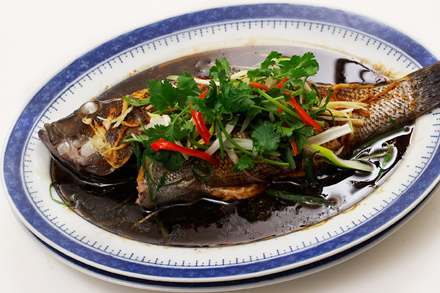
If you still have an appetite after watching the vidoes and can find very fresh fish then try this recipe. Be sure to cook the fish on the same day you purchase! It’s for an incredible Steamed Sea Bass (清蒸魚), a classic Cantonese steamed fish dish.
Steamed Sea Bass ((清蒸魚)
Ingredients
- 2 lbs. sea bass (whole)
For steaming
- 1 tablespoon Shaoxing cooking wine (紹興料酒)
- 4 slices fresh ginger
- 1/2 teaspoon ground white pepper
Sauce
- 2 tablespoons light soy sauce
- 2 tablespoons Shaoxing cooking wine (紹興料酒)
- 1 teaspoon sugar
- 3 tablespoons vegetable oil
Garnish
- 1/4 cup fresh ginger finely julienned
- 1/4 cup fresh scallion finely julienned
- 4 sprigs of cilantro
Instructions
- You can substitute sea bass with other type of fish of similar size, but do not use overly flakey fish. Ask the fishmonger to clean and scale the fish but leave the tail and fins on. Before cooking use the back of a knife and scrap off any stray scales especially on the head and belly.
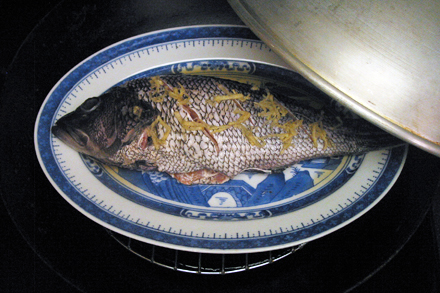
- Slash the body of the fish diagonally at three places an inch apart on both sides. Place the fish on an oval plate. Spread one tablespoon each of Shaoxing cooking wine and shredded ginger, plus 1/2 teaspoon of white pepper on top of the fish. Let stand for about 15 minutes.
- Heat about 5 cups of water in a wok over high heat and put a wire rack over it. Steam the fish on the rack with a cover when water started boiling. Steam for about 15 minutes or until the flesh on the body comes off easily from the bones.
- While the fish is steaming combine the soy sauce, Shaoxing wine and sugar in a bowl and set aside for use as a sauce. Heat the vegetable oil in a small saucepan until just about smoking stage. When the fish is ready remove the plate from the wok using a plate lifter. Pour the soy sauce mixture all over the fish, and then pour the hot oil as well. Be very careful when you pour the hot oil as it will splatter.
- Garnish the fish with the shredded ginger, shredded scallion, and cilantro. Be sure not to skip the garnish, as it is part of the flavoring for the completed dish.



So well written! I am a big seafood lover, and I’m accustomed to buying fish still swimming in tanks in the supermarket. But I am very glad to don’t have to clean and gut a fish. In some Asian markets, they even fry if for you after cleaning.
Wendy Chan
Whenever I think of the American aversion of meat that actually looks like an animal, A Christmas Story comes to mind. The little kid bursting in tears when the Chinese kitchen brings out a whole duck with head on seems to be what many adults want to do in the same situation. 🙂
Kian –
I love this post because it exposes our (my) true hypocrisy. For all our American chit chat about sustainability, eating local and knowing where our food comes from, we still are squeamish when we are confronted with being that closely connected to the food chain.
Still, I ran screaming from your apartment when I saw these videos because I don’t think I could eat something still gasping for air on the plate and I know I couldn’t scale and gut a fish while it was still alive. I know my American upbringing has made me squeamish and hypocritical, but I’ll take my fish dead and my meat in slabs on styrofoam. Guilty as charged.
Kim
OMG this is so true! I couldn’t even bring myself to watch the videos 😉 I have to admit that I don’t want to think about the fact that my food was once alive. Just another example of how deeply ingrained our cultural perceptions about food are. Great post; great site!
I must admit that I did not watch the videos either, but we do a lot of fishing in the gulf of mexico and the bahamas and the fish we catch and eat there are quite alive! We even do sashimi many times … it is all what you get used to.
Denise
http://www.WineFoodPairing.blogspot.com
Oh my…. poor fish. Can you just eat it after it’s dead, I know the food will become just a regular dish, but at least it would be better for the fish.
This post is towards the videos not the article
im sorry, but i find this pretty disturbing, i have no quams with eating meat that looks like an animal, but keeping it alive whilst gutting and cooking it is cruel, unnecessary and from the chefs point of view, lacking human decency.
You wouldnt do all this to any kind of livestock, so why to a fish??
I have no problem with fresh fish, keeping it alive right up untill the point of preperation is the best possible way the dish could be cooked, but to do so whilst it is still alive is sick.
for arguments sake, lets say we wern’t top of the food chain, and you were to be skinned, gutted and cooked alive, would you be happy about it??
whislt a fish doesnt have the same intellegence or morals as a human, it still feels pain, and surely any decent human being could empathise with this
sorry if i’ve offended anyone but i find this sadisctic and inhumane
I am in no sense of the word an animal activist (infact i despise most of their methods and arguments), nor am i trying to brew trouble, I am simply saying gutting and cooking a fish still alive is completely wrong.
and no I am not american!!
More attention should be paid to the excellent recipe and less to the video.
And regarding the recipe, the scallions, ginger and cilantro should be sprinkled over the fish just before the hot oil is poured on, not after. Makes a world of difference in the flavor of the sauce that results.
I did not watch the videos… I’ve seen one like it before. I am an American and I have no problem with my fish looking like a fish, chicken looking like a chicken, etc… We have butchered a deer in our backyard. I am not squeamish. I am interested in treating animals as humanely as possible, even when they are to be killed and eaten. I think it is sick and cruel to treat a fish or any other creature this way, simply for one’s culinary enjoyment.
I am an American but raised in Thailand for most of my life (except in my teen years I was sent back to the US on summers to get a summer job).
I get the concept of having your fish as fresh as possible when you eat it. But eating a fish with its head still breathing is plain disgusting, even by Thai standards. I mean a friggin fish, come on. I’m not a vegetarian or even close to one. In fact, I am an avid fisherman.
I have no problems with my food looking like an animal (and I prefer deep fried whole fish rather than just the filets. I really dont give a shit that my food was once alive, and this is one thing im happy that I wasnt raised in America. I take a mallet to the head of the fish, and once its dead, remove scales and guts ASAP, cut slits in the side and throw it in the frying pan. Or cut the head off if you want to. But keeping the head still bobbing and breathing, screw that.
However, contradictory to what I said above, the video of the octopus actually looks kinda delicious. Dont cook it, eat it fresh thats the best way. I guess I’m only affected when its an animal with a spine thats being cooked and eaten alive.
I’ve caught, cleaned and cooked my own fish often enough. I’ve even done the fabrication (break down) on chicken, beef, and deer. I’ve never had issue with food looking like what it is. However, it seems completely crude to me to cook and serve a breathing creature.
I attended culinary school with several international students and doubt that many of them would be OK with cooking an animal with the purpose of keeping it alive. Many of them had issues with boiling the lobsters alive so I cannot see most of them being happy about this practice.
On a side note, your recipe looks wonderful and I can’t wait to try it.